
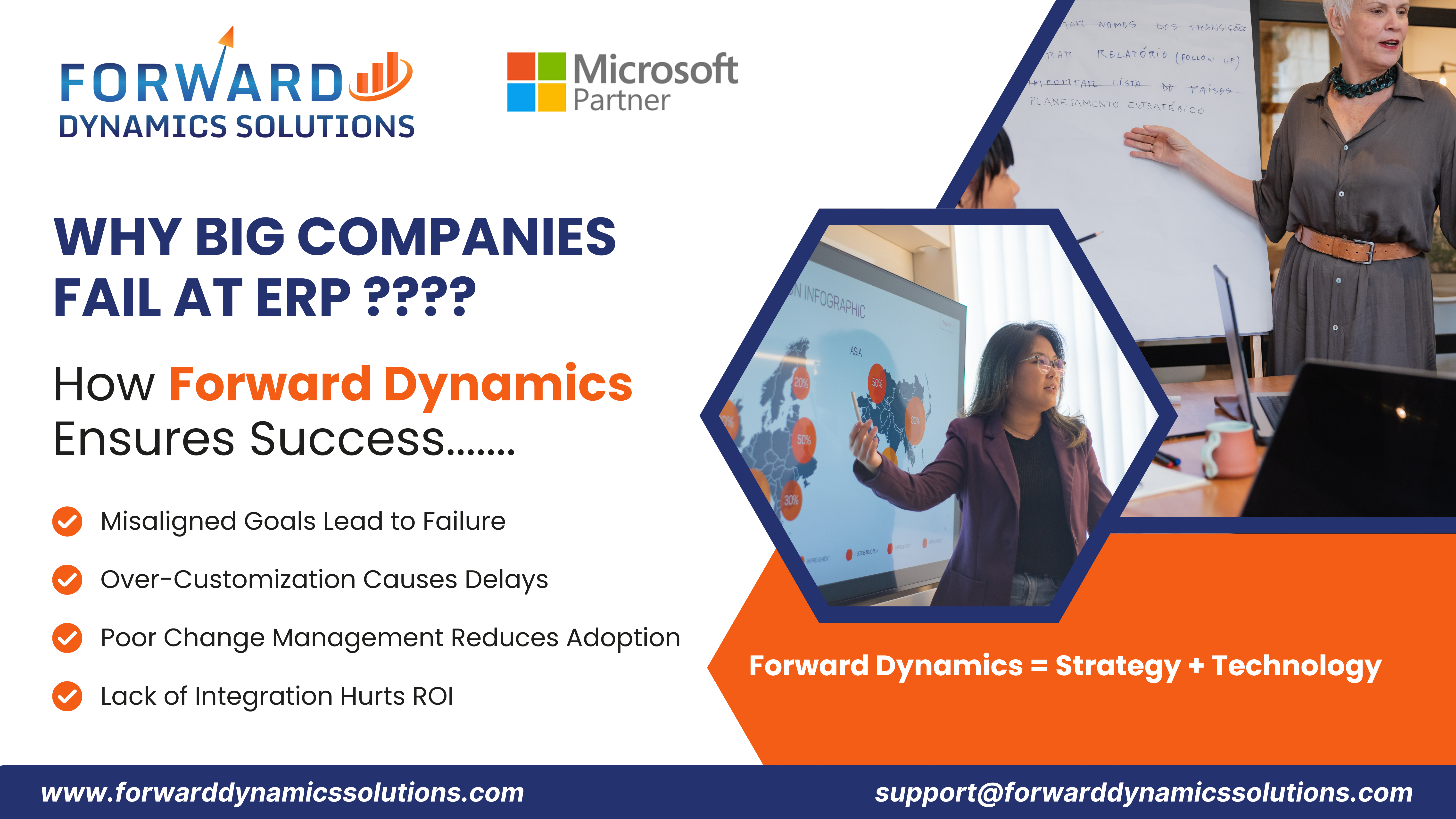
ERP projects represent some of the most important technology investments organizations make. Business leaders invest in enterprise resource planning systems to improve efficiency, connect departments, strengthen reporting, and support future growth. Yet many organizations struggle to achieve the outcomes they originally envisioned.
The challenge rarely comes from the software itself. Modern ERP platforms such as Microsoft Dynamics 365 provide powerful capabilities that help organizations manage operations, finances, supply chains, customer relationships, and business intelligence from a unified environment.
Success depends on planning, alignment, adoption, and execution.
Organizations that approach ERP as a business transformation initiative often experience stronger results, faster adoption, and greater long-term value. Companies that focus solely on technology frequently miss opportunities to maximize their investment.
Forward Dynamics Solutions helps organizations bridge this gap. Through strategic consulting, industry expertise, proven methodologies, and Microsoft Dynamics 365 specialization, Forward Dynamics helps businesses transform ERP from a technology project into a growth-focused business initiative.
This guide explores common ERP implementation challenges, the factors that influence project success, and how Forward Dynamics helps organizations create sustainable business value through Microsoft Dynamics 365.
Why Do Many ERP Projects Fall Short of Business Expectations?
ERP projects often begin with excitement and ambitious goals. Leadership teams expect improved efficiency, better reporting, stronger collaboration, and greater visibility across the organization. Achieving those outcomes depends on more than software deployment. Success requires a clear strategy, organizational alignment, and a commitment to long-term business improvement.
Industry studies from Panorama Consulting have reported that a significant percentage of 30–50% ERP projects experience challenges related to scope, budget, timeline management, or business adoption, highlighting the importance of planning and execution.
Unclear Business Objectives Create Directional Challenges
Many organizations begin ERP projects with broad goals such as improving efficiency or modernizing systems. While these objectives provide direction, successful projects require measurable outcomes that guide decision-making throughout implementation.
Without clearly defined objectives, teams often encounter competing priorities and uncertainty regarding project success.
Examples of effective ERP goals include:
- Improved Financial Visibility: Faster access to financial data supports better business planning and forecasting.
- Enhanced Operational Efficiency: Streamlined workflows reduce manual effort across departments.
- Better Customer Experience: Connected business processes improve service delivery and responsiveness.
- Scalable Growth Support: Modern systems support expansion without creating operational bottlenecks.
When objectives remain clear, every implementation decision supports meaningful business outcomes.
Executive Alignment Supports Stronger Project Outcomes
Leadership involvement plays a significant role in ERP success.
When executive teams actively participate in planning, communication, and decision-making, projects gain stronger organizational support.
Executive alignment helps organizations:
- Establish Priorities: Leadership defines what success looks like across departments.
- Allocate Resources: Teams receive the support necessary to complete project activities.
- Encourage Adoption: Employees gain confidence when leaders champion transformation initiatives.
- Maintain Momentum: Projects remain focused on strategic goals throughout implementation.
Forward Dynamics encourages active executive participation from project initiation through post-deployment optimization.
Process Complexity Expands Project Scope
Large organizations often operate with years of established procedures, departmental workflows, and specialized requirements.
During ERP implementation, these processes require careful evaluation.
Common areas that increase complexity include:
- Multiple Approval Structures: Complex workflows require clear documentation and optimization.
- Department-Specific Procedures: Teams may follow unique operational practices.
- Manual Processes: Existing workarounds often create inefficiencies that need attention.
- Data Dependencies: Business information frequently resides across multiple systems.
Forward Dynamics works closely with stakeholders to identify opportunities for process improvement while preserving operational continuity.
Limited User Engagement Slows Adoption
Employees interact with ERP systems daily. Their participation during implementation significantly influences project outcomes.
Organizations that involve users early often experience smoother transitions and faster adoption.
User engagement activities include:
- Requirements Workshops: Employees share operational insights and business needs.
- Process Reviews: Teams validate workflows and identify improvement opportunities.
- Testing Participation: Users confirm functionality supports daily operations.
- Training Programs: Practical learning experiences build confidence before launch.
When employees understand the purpose and benefits of the new system, adoption becomes a natural part of the transformation journey.
Common ERP Challenges Large Organizations Encounter
Every ERP project introduces opportunities for growth and improvement. Along the way, organizations encounter challenges that require thoughtful planning and expert guidance. Understanding these common obstacles helps businesses create stronger implementation strategies and achieve better outcomes.
Legacy Systems Create Data and Integration Complexity
Many organizations rely on a combination of legacy applications, spreadsheets, databases, and department-specific solutions.
Over time, these systems accumulate large volumes of business-critical information.
During ERP modernization, organizations often address:
- Historical Data Management: Years of operational records require evaluation and migration planning.
- System Connectivity: Existing applications need seamless integration with the new ERP platform.
- Data Standardization: Information from multiple sources requires consistency and accuracy.
- Reporting Consolidation: Leadership teams seek unified visibility across operations.
Forward Dynamics uses structured migration methodologies that help organizations transition data efficiently while maintaining accuracy and business continuity.
Excessive Customization Increases Risk and Cost
ERP platforms provide extensive capabilities that support a wide range of industries and business models.
Organizations occasionally attempt to recreate every historical process through extensive customization.
A balanced approach often delivers stronger long-term value.
Benefits of focusing on standard functionality include:
- Faster Implementation Timelines: Proven features reduce development effort.
- Easier Upgrades: Future enhancements integrate more efficiently.
- Lower Maintenance Requirements: Standard processes support long-term scalability.
- Improved User Experience: Employees work within familiar Microsoft environments.
Forward Dynamics helps organizations evaluate customization opportunities strategically, ensuring technology supports business goals effectively.
Resource Constraints Delay Critical Milestones
ERP projects require collaboration between business leaders, subject matter experts, technical teams, and implementation partners.
Resource availability influences project progress.
Common considerations include:
- Subject Matter Expertise: Operational knowledge supports effective decision-making.
- Project Ownership: Clear accountability keeps initiatives moving forward.
- Stakeholder Participation: Timely feedback helps maintain momentum.
- Training Readiness: Employees need dedicated time to prepare for new processes.
Forward Dynamics works with organizations to create realistic project plans that align with available resources and business priorities.
Change Management Drives Successful Transformation
ERP implementation represents a business transformation initiative rather than a technology upgrade.
Successful organizations invest in communication, training, and adoption planning throughout the project lifecycle.
Effective change management includes:
- Clear Communication: Employees understand project goals and expected benefits.
- Leadership Support: Executive involvement reinforces organizational commitment.
- Role-Based Training: Teams receive guidance relevant to their responsibilities.
- Continuous Engagement: Ongoing feedback encourages participation and improvement.
Organizations that prioritize structured adoption strategies frequently experience stronger project outcomes and faster realization of business value.
Forward Dynamics incorporates change management practices throughout implementation to help organizations create lasting success.
The organizations that achieve the greatest ERP success understand that technology serves as a foundation for broader business improvement. Through strategic planning, executive alignment, user engagement, and expert guidance, ERP becomes a powerful tool that supports growth, efficiency, and long-term operational excellence.
Forward Dynamics ERP Success Framework
Successful ERP projects follow a structured path. They begin with clear business objectives, continue through careful planning and execution, and evolve through ongoing optimization. Forward Dynamics Solutions uses a proven framework that helps organizations move confidently from planning to measurable business outcomes. This approach combines Microsoft expertise, industry knowledge, and practical implementation strategies to help businesses maximize the value of their ERP investment.
According to PMI research, organizations that follow structured project management practices consistently achieve higher project success rates and stronger business outcomes.
Strategic Discovery Creates a Clear Transformation Roadmap
Every successful ERP initiative begins with understanding the business behind the technology.
Forward Dynamics starts with comprehensive discovery sessions that help identify:
- Business Objectives: Understanding growth goals, operational priorities, and strategic initiatives.
- Current Process Evaluation: Reviewing workflows, reporting structures, and system dependencies.
- Technology Assessment: Analyzing current platforms and integration requirements.
- Future-State Planning: Creating a vision that supports long-term scalability.
This discovery phase helps eliminate uncertainty while creating a roadmap that aligns technology with business goals.
Organizations gain clarity regarding project timelines, deliverables, milestones, and expected outcomes.
A strong foundation supports smoother execution throughout the implementation journey.
Business-Centered Design Aligns Technology With Goals
Technology should support business objectives rather than dictate them.
Forward Dynamics focuses on designing ERP solutions that reflect how organizations operate while creating opportunities for process improvement.
This includes:
- Financial Process Optimization: Supporting accurate reporting and financial visibility.
- Operational Efficiency Improvements: Simplifying workflows across departments.
- Reporting Enhancements: Delivering real-time business insights.
- Customer Experience Support: Creating stronger connections between departments and customers.
Rather than applying a one-size-fits-all approach, Forward Dynamics develops solutions that align with each organization’s unique priorities.
This business-centered strategy creates stronger adoption and greater long-term value.
Agile Delivery Accelerates Deployment Progress
Modern ERP projects benefit from agility and continuous collaboration.
Forward Dynamics follows agile implementation principles that support flexibility and transparency.
Key advantages include:
- Incremental Progress Reviews: Stakeholders evaluate progress regularly.
- Faster Decision-Making: Teams address opportunities and questions efficiently.
- Greater Visibility: Leadership remains informed throughout the project.
- Continuous Improvement: Feedback supports ongoing refinement.
Agile delivery helps organizations maintain momentum while ensuring project activities remain aligned with business goals.
Instead of waiting for major milestones to evaluate progress, stakeholders participate throughout the implementation lifecycle.
This collaborative approach supports stronger outcomes and greater confidence.
Governance and Risk Management Protect Project Success
Successful ERP projects rely on strong governance structures.
Forward Dynamics establishes clear project management practices that support accountability and transparency.
Governance activities include:
- Executive Steering Committees: Leadership provides strategic oversight.
- Regular Status Reviews: Teams monitor progress against project goals.
- Risk Assessments: Potential challenges receive proactive attention.
- Decision Frameworks: Stakeholders resolve priorities efficiently.
Strong governance creates alignment across departments while supporting informed decision-making.
Organizations gain confidence knowing project activities remain connected to strategic objectives.
Ready to modernize your ERP environment with confidence?
How Does Forward Dynamics Remove ERP Implementation Risk?
Every ERP project involves important decisions that influence business operations, employee productivity, and long-term growth. Organizations benefit from implementation partners that understand how to anticipate challenges, create clear plans, and guide teams through every stage of transformation. Forward Dynamics combines proven methodologies with practical experience to help organizations reduce uncertainty and achieve stronger outcomes.
Proven Methodologies Support Predictable Outcomes
ERP implementation becomes more effective when teams follow repeatable processes that have delivered success across multiple projects.
Forward Dynamics uses established methodologies that support:
- Consistent Project Delivery: Structured activities help maintain momentum.
- Clear Communication: Stakeholders remain informed throughout the process.
- Defined Responsibilities: Teams understand expectations and ownership.
- Measurable Progress: Milestones provide visibility into project advancement.
This disciplined approach helps organizations move forward with confidence while maintaining focus on business priorities.
Proven methodologies also support scalability, allowing businesses to adapt solutions as requirements evolve.
Early Risk Identification Reduces Project Disruptions
Every project presents opportunities that require thoughtful planning.
Forward Dynamics focuses on identifying key considerations early in the process to support smooth execution.
Areas reviewed include:
- Data Quality: Ensuring information supports accurate reporting and operations.
- Integration Requirements: Evaluating connections between business systems.
- Resource Planning: Aligning personnel with project responsibilities.
- Operational Readiness: Preparing departments for process changes.
Addressing these areas early creates a proactive environment where teams can focus on achieving project goals efficiently.
This preparation helps organizations maintain productivity while advancing transformation initiatives.
Transparent Communication Strengthens Stakeholder Confidence
Communication plays a significant role in ERP success.
Forward Dynamics emphasizes transparency throughout every phase of implementation.
Benefits of transparent communication include:
- Greater Alignment: Stakeholders share a common understanding of project goals.
- Faster Resolution: Questions receive timely attention.
- Increased Participation: Teams remain engaged and informed.
- Stronger Trust: Visibility supports confidence in project progress.
Regular updates, milestone reviews, and collaborative planning sessions help maintain momentum and organizational support.
When stakeholders remain connected to project activities, decision-making becomes more efficient and productive.
Structured Testing Protects Operational Continuity
Testing helps ensure ERP solutions support business operations effectively before deployment.
Forward Dynamics incorporates comprehensive testing activities throughout implementation.
Testing phases include:
- Functional Validation: Confirming business processes perform as expected.
- Data Verification: Ensuring accuracy and consistency.
- Integration Testing: Evaluating connections between systems.
- User Acceptance Testing: Validating real-world business scenarios.
This structured approach helps organizations prepare for deployment while building confidence among employees and stakeholders.
By involving users throughout testing activities, organizations gain valuable feedback that supports adoption and long-term success.
Change Management Encourages Business Readiness
ERP success extends beyond technology deployment.
Employees play a central role in realizing business value.
Forward Dynamics helps organizations prepare for transformation through:
- Role-Based Training Programs: Tailored learning experiences for different teams.
- Communication Strategies: Sharing project updates and business benefits.
- Leadership Engagement: Reinforcing organizational commitment.
- Continuous Support: Helping users gain confidence with new processes.
When employees understand how ERP supports their daily work, adoption becomes more natural and productive.
Organizations often experience faster realization of benefits when change management remains a priority throughout implementation.
Long-Term Partnership Creates Ongoing Value
Forward Dynamics views ERP implementation as the beginning of a long-term relationship.
Following deployment, organizations continue receiving support through:
- Performance Reviews: Evaluating system effectiveness.
- Process Optimization: Identifying opportunities for improvement.
- Feature Expansion: Leveraging new Microsoft capabilities.
- Strategic Guidance: Supporting future growth initiatives.
This commitment helps organizations maximize their Microsoft Dynamics investment while adapting to changing business needs.
The result is a technology environment that supports continuous improvement, innovation, and sustainable growth.
Forward Dynamics combines planning, governance, communication, testing, and ongoing support to create ERP implementations that deliver measurable value while supporting long-term business success.
Why Does Microsoft Dynamics 365 Support Sustainable Growth?
Growth brings new opportunities, customers, products, locations, and operational demands. As organizations expand, they need systems that help teams stay connected, informed, and productive.
Microsoft Dynamics 365 provides a unified business platform that supports these goals by connecting data, processes, and people across the organization. Forward Dynamics helps businesses unlock these capabilities through strategic implementation and industry-focused expertise.
Unified Business Applications Improve Organizational Visibility
One of the biggest advantages of Microsoft Dynamics 365 comes from its ability to bring multiple business functions together within a connected environment.
Instead of working across separate systems, teams can access information from a centralized platform.
Benefits include:
- Financial Visibility: Finance teams gain access to accurate and timely reporting.
- Operational Alignment: Departments work from the same source of information.
- Customer Insights: Sales and service teams access a complete customer view.
- Improved Collaboration: Teams share information more effectively.
When information flows across departments, leadership gains a clearer understanding of business performance and opportunities.
This visibility supports stronger decision-making and operational efficiency.
Real-Time Insights Support Better Decision-Making
Business leaders rely on accurate information to make strategic decisions.
Microsoft Dynamics 365 provides real-time reporting and analytics that help organizations monitor performance across key areas.
Organizations benefit from:
- Interactive Dashboards: Leadership teams access performance metrics instantly.
- Financial Reporting: Real-time visibility supports planning and forecasting.
- Operational Monitoring: Teams identify opportunities for improvement quickly.
- Customer Analytics: Sales and service activities become easier to evaluate.
Power BI integration enhances these capabilities by transforming data into meaningful visual insights.
Forward Dynamics helps businesses configure reporting environments that align with organizational goals and key performance indicators.
Flexible Architecture Supports Business Expansion
Growth often creates new requirements that traditional systems struggle to support.
Microsoft Dynamics 365 provides flexibility that allows organizations to scale according to their needs.
Scalability benefits include:
- Modular Deployment: Organizations can implement capabilities based on priorities.
- Multi-Entity Management: Businesses can manage multiple locations and divisions efficiently.
- Global Expansion Support: Operations across regions remain connected.
- Process Adaptability: New workflows can be introduced as business needs evolve.
This flexibility helps organizations create a technology foundation that supports long-term growth without requiring major system changes.
Forward Dynamics helps businesses design ERP environments that support current operations while preparing for future opportunities.
Cloud Innovation Enhances Security and Accessibility
Modern organizations require secure access to information regardless of location.
Microsoft Dynamics 365 delivers cloud-based capabilities that support:
- Remote Workforce Productivity: Employees access systems securely from anywhere.
- Business Continuity: Cloud infrastructure supports operational resilience.
- Automatic Updates: Organizations gain access to new features and improvements regularly.
- Enterprise-Grade Security: Built-in controls help protect business information.
Cloud technology allows organizations to focus on growth and innovation while benefiting from a reliable and scalable platform.
Forward Dynamics helps organizations navigate cloud transformation strategies that align with business objectives and security requirements.
How Does Forward Dynamics Tailor ERP Solutions Across Industries?
Every industry operates differently. Manufacturers manage production schedules, distributors coordinate inventory movement, nonprofits track donor activity, and financial institutions focus on compliance and reporting.
A successful ERP implementation recognizes these differences and aligns technology with operational needs. Forward Dynamics combines Microsoft expertise with industry knowledge to help organizations achieve meaningful results.
Manufacturing Organizations Gain Operational Visibility
Manufacturing companies operate in highly coordinated environments where efficiency and visibility directly influence performance.
Forward Dynamics helps manufacturers leverage Microsoft Dynamics 365 to improve:
- Production Planning: Better scheduling supports operational efficiency.
- Inventory Management: Real-time visibility improves inventory control.
- Supply Chain Coordination: Connected processes strengthen collaboration.
- Financial Reporting: Leadership gains access to accurate performance metrics.
Manufacturers benefit from improved decision-making, stronger resource management, and greater operational transparency.
Forward Dynamics works closely with manufacturing teams to configure solutions that align with production workflows and growth objectives.
Financial Institutions Strengthen Compliance and Reporting
Financial organizations require systems that support accuracy, accountability, and visibility.
Microsoft Dynamics 365 helps financial institutions improve:
- Regulatory Reporting: Consistent reporting supports compliance objectives.
- Financial Controls: Automated workflows enhance governance.
- Operational Visibility: Leadership gains greater insight into business performance.
- Risk Management: Better information supports informed decision-making.
Forward Dynamics understands the importance of aligning technology with regulatory requirements while creating efficient business processes.
This approach helps financial organizations improve performance while supporting long-term growth.
Agriculture Businesses Improve Resource Planning
Agriculture organizations manage a wide range of operational activities that require careful planning and coordination.
Forward Dynamics helps agriculture businesses enhance:
- Resource Allocation: Better planning supports productivity.
- Inventory Tracking: Real-time information improves operational visibility.
- Financial Management: Accurate reporting supports business planning.
- Forecasting Capabilities: Data-driven insights improve decision-making.
Modern ERP solutions help agriculture organizations operate more efficiently while adapting to changing business requirements.
Forward Dynamics brings practical expertise that helps agriculture companies maximize the value of their technology investment.
Distribution and Nonprofit Organizations Accelerate Performance
Distribution companies and nonprofit organizations face unique challenges that benefit from connected business systems.
For distribution organizations, Dynamics 365 supports:
- Inventory Optimization: Better visibility improves inventory control.
- Order Management: Streamlined processes support customer satisfaction.
- Supplier Collaboration: Connected information improves coordination.
- Financial Visibility: Reporting supports business growth.
For nonprofit organizations, Dynamics 365 helps improve:
- Donor Management: Centralized information supports engagement.
- Grant Tracking: Better visibility improves accountability.
- Financial Oversight: Accurate reporting supports transparency.
- Stakeholder Communication: Connected systems strengthen relationships.
Forward Dynamics tailors ERP solutions to align with industry-specific priorities while supporting sustainable growth.
Explore Microsoft Dynamics 365 solutions built around your industry goals.
Microsoft Dynamics 365 and Power Platform Working Together for Greater Value
Technology delivers greater value when systems work together seamlessly. Microsoft Dynamics 365 provides a strong ERP foundation, while Microsoft Power Platform expands capabilities through reporting, automation, application development, and digital engagement. Together, these solutions help organizations improve efficiency, strengthen decision-making, and support continuous innovation.
Power BI Transforms Data Into Actionable Intelligence
Business data becomes more valuable when leaders can understand it quickly.
Power BI helps organizations turn operational and financial information into meaningful insights through interactive dashboards and reports.
Benefits include:
- Executive Visibility: Leadership teams access real-time performance metrics.
- Financial Reporting: Organizations monitor profitability and growth trends.
- Operational Analysis: Departments gain visibility into key activities.
- Performance Tracking: Teams evaluate results against business goals.
Forward Dynamics helps organizations design reporting environments that support informed decision-making across all levels of the business.
Power Apps Accelerates Process Innovation
Many organizations rely on processes that can benefit from greater flexibility and automation.
Power Apps allows businesses to create custom applications that address unique operational needs.
Examples include:
- Field Service Applications: Teams capture information while working remotely.
- Approval Workflows: Processes move more efficiently across departments.
- Inventory Tracking Tools: Employees gain access to real-time updates.
- Data Collection Solutions: Information enters business systems more quickly.
Forward Dynamics helps organizations identify opportunities where custom applications can improve efficiency and productivity.
Power Automate Streamlines Business Operations
Automation creates opportunities to reduce repetitive work while improving consistency.
Power Automate helps organizations connect systems and automate routine activities.
Benefits include:
- Workflow Automation: Tasks move automatically between departments.
- Notification Management: Teams receive updates when important activities occur.
- Data Synchronization: Information remains consistent across platforms.
- Process Efficiency: Employees focus on higher-value activities.
Organizations often experience measurable productivity improvements when automation becomes part of their digital strategy.
Power Pages Expands Customer and Partner Experiences
Digital engagement continues to become an important part of business growth.
Power Pages helps organizations create secure portals for customers, vendors, and partners.
Organizations benefit from:
- Self-Service Access: Users access information conveniently.
- Enhanced Communication: Stakeholders interact through digital channels.
- Improved Efficiency: Teams spend less time managing manual requests.
- Better User Experiences: Information becomes easier to access and manage.
Forward Dynamics helps organizations develop portal strategies that support customer engagement and operational efficiency.
What Happens After ERP Go-Live?
Go-live represents an important milestone, yet it marks the beginning of a new phase rather than the final destination. Organizations achieve the greatest value from ERP investments through continuous improvement, optimization, and strategic planning. Forward Dynamics remains engaged after deployment to help businesses maximize long-term success.
Continuous Optimization Enhances Long-Term Performance
Business needs evolve.
As organizations grow, new opportunities emerge to improve processes, reporting, and system utilization.
Continuous optimization focuses on:
- Workflow Improvements: Streamlining operational activities.
- Reporting Enhancements: Expanding business visibility.
- Feature Adoption: Leveraging new Microsoft capabilities.
- Process Refinement: Supporting efficiency improvements.
Forward Dynamics helps clients identify opportunities that increase the value of their ERP investment over time.
Managed Support Strengthens System Reliability
Reliable support contributes to ongoing business success.
Forward Dynamics provides services that help organizations maintain strong system performance.
Support activities include:
- Performance Monitoring: Evaluating system health and usage.
- User Assistance: Helping employees navigate business processes.
- Issue Resolution: Addressing operational questions efficiently.
- Strategic Recommendations: Supporting future growth initiatives.
This proactive approach helps organizations maintain productivity and confidence.
User Development Expands Business Value
Employees continue discovering new ways to use ERP systems long after implementation.
Forward Dynamics supports ongoing learning through:
- Advanced Training Programs: Expanding employee capabilities.
- Knowledge Transfer Sessions: Sharing best practices.
- Role-Based Education: Supporting specific business functions.
- Feature Awareness Programs: Introducing new capabilities.
As user knowledge grows, organizations often uncover additional opportunities for efficiency and innovation.
Innovation Planning Supports Future Opportunities
Technology continues to advance rapidly.
Forward Dynamics helps organizations stay aligned with Microsoft’s product roadmap and innovation strategy.
Areas of focus include:
- Artificial Intelligence Adoption
- Process Automation Opportunities
- Reporting Expansion
- New Application Capabilities
This long-term perspective helps organizations remain competitive while maximizing their technology investment.
Future ERP Trends Shaping Enterprise Transformation
ERP technology continues evolving to support changing business requirements. Organizations that understand emerging trends position themselves to take advantage of new opportunities while improving operational performance.
Artificial Intelligence Enhances Operational Efficiency
Artificial intelligence plays an increasingly important role within modern ERP platforms.
Microsoft Copilot helps organizations improve productivity through:
- Intelligent Recommendations: Supporting informed decision-making.
- Content Assistance: Helping teams work more efficiently.
- Data Analysis: Turning information into actionable insights.
- Process Support: Simplifying routine activities.
Forward Dynamics helps organizations explore AI opportunities that align with business goals.
Predictive Analytics Supports Smarter Planning
Predictive analytics allows organizations to use historical data and trends to guide future decisions.
Benefits include:
- Improved Forecasting
- Better Resource Planning
- Stronger Financial Management
- Enhanced Operational Visibility
Organizations gain greater confidence when planning growth strategies and operational initiatives.
Connected Platforms Create Greater Business Agility
Modern organizations benefit from connected business environments where information flows across systems seamlessly.
Integrated platforms support:
- Cross-Department Collaboration
- Faster Decision-Making
- Improved Customer Experiences
- Operational Consistency
Microsoft Dynamics 365 and Power Platform help create these connected environments.
Data-Driven Organizations Gain Competitive Advantages
Data remains one of the most valuable business assets.
Organizations that use data effectively often achieve stronger outcomes in areas such as:
- Customer Engagement
- Financial Performance
- Operational Efficiency
- Strategic Planning
Forward Dynamics helps businesses build data-driven cultures supported by modern Microsoft technologies.
Conclusion
ERP success depends on much more than software selection. Organizations achieve the greatest results when technology aligns with business goals, leadership teams remain engaged, employees participate actively, and implementation follows a structured methodology.
Large organizations often encounter challenges related to planning, adoption, process complexity, and system integration. With the right strategy and guidance, these challenges become opportunities for improvement and growth.
Forward Dynamics Solutions helps organizations navigate every stage of the ERP journey. Through strategic consulting, Microsoft Dynamics 365 expertise, industry-focused solutions, and ongoing support, the company helps businesses create meaningful transformation outcomes.
From discovery and implementation to optimization and innovation, Forward Dynamics serves as a trusted partner committed to long-term success.
Organizations that invest in modern ERP platforms gain access to stronger visibility, improved efficiency, connected operations, and scalable growth opportunities.
With the right foundation in place, ERP becomes more than a technology solution. It becomes a business asset that supports sustainable growth, informed decision-making, and future success.
